
Rooms
Master Bedroom Ideas That Actually Make the Room Restful
August 24, 2026 · 9 min read
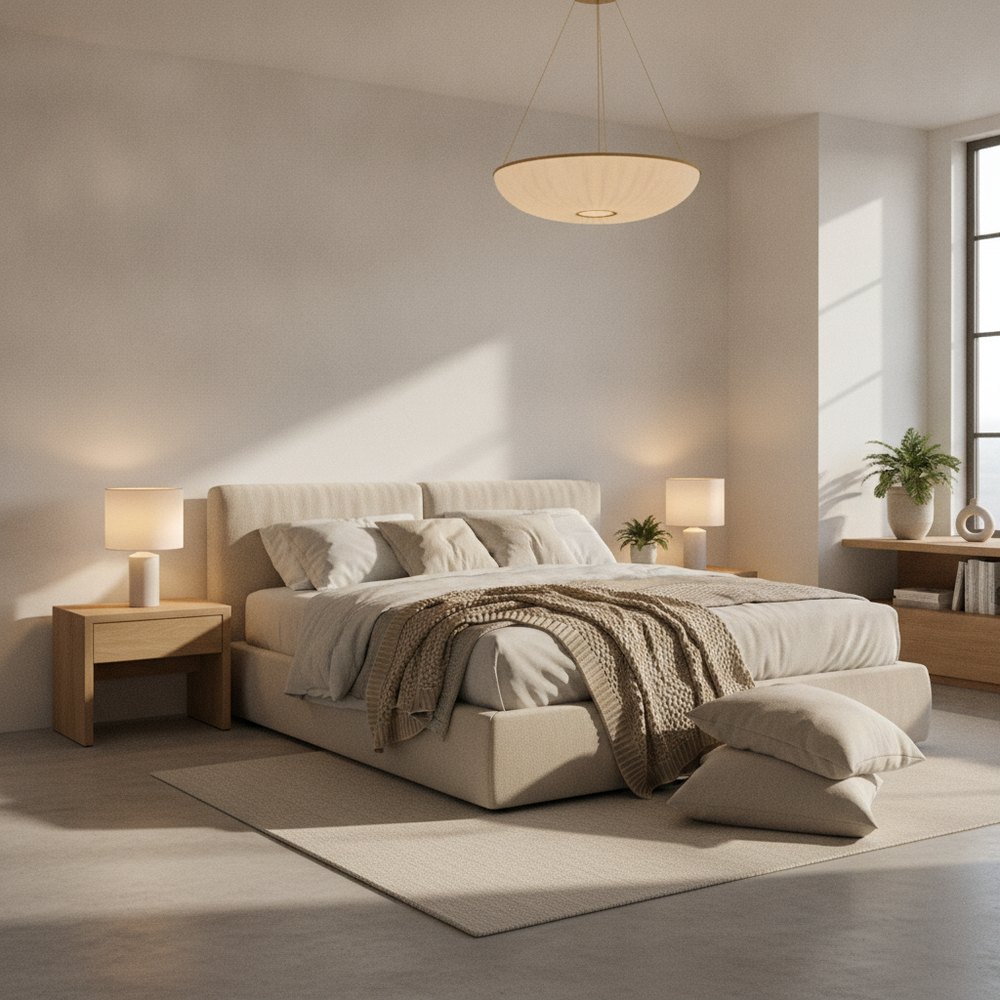
A restful master bedroom comes down to four decisions: put the bed on the wall you see first when you enter, use three light sources and no bright ceiling light, keep the palette to three warm tones, and get every piece of storage behind a door. Everything else is decoration.
Why bigger bedrooms often feel worse
It is a genuinely common complaint: people move into a house with a large main bedroom and find it less restful than the small one they left.
The reason is that a large bedroom has room for things that do not belong in a bedroom. A desk creeps in. A clothes rail. A treadmill nobody uses. Laundry accumulates in a corner because there is a corner to accumulate in. A small bedroom is disciplined by its size; a large one has to be disciplined on purpose.
The other reason is scale. A double bed that filled a small room looks marooned in a large one, and furniture that is too small for a space makes the space feel unresolved rather than generous.
Getting the layout right
There is a short hierarchy of decisions and they are best made in this order.
- 1Place the bed on the wall you see when you walk in. Not necessarily the largest wall, and specifically not under the window if you can avoid it, which is cold in winter and awkward for curtains.
- 2Leave 700mm minimum on both sides and at the foot. Below that the room becomes a shuffle. In a large room, 900mm is more comfortable.
- 3Match the bedsides. Symmetry either side of the bed does more for a restful feel than any single purchase. Two of the same lamp beats two nicer mismatched ones.
- 4Put storage on the wall behind the door, so it is the thing you see least.
- 5Then, if there is room left, add one chair. Not a suite; one chair, ideally near a window.
The lighting rule that changes the room
If you change one thing after reading this, change the lighting, because it costs the least and does the most.
Almost every bedroom is lit by a single ceiling fixture, which is the worst possible arrangement for a room whose main function is winding down. Overhead light flattens the space, casts unflattering shadows, and signals daytime to your brain at exactly the moment you are trying to persuade it otherwise.
The replacement is three sources at different heights: bedside lights at pillow height, ideally wall-mounted to free the surface, something in a corner such as a floor lamp, and, if there is a dressing area, a light there. All warm, around 2700K, all on dimmers or low-output bulbs. Keep the ceiling light for finding a lost earring and use it for nothing else.
Palette: three warm tones
Bedrooms are the one room where the palette advice is genuinely simple.
Pick three tones that sit close together and lean warm: for example a warm off-white, a soft clay and a muted olive, or an oatmeal, a taupe and a deep brown. Then apply them at different scales, walls, textiles, one piece of furniture. The narrowness of the palette is what produces calm, and warmth is what stops it feeling clinical.
The exception worth knowing is the fully saturated dark bedroom: everything, walls and ceiling, in one deep colour. It sounds oppressive and it is often the most restful room in a house, because there are no boundaries for your eye to trace. If you have a small or awkward master bedroom, it is worth rendering before you dismiss it. Our guide to wall colour psychology covers what different families do.
The headboard question
A headboard does more than it looks like it does, and skipping it is why some otherwise well-furnished bedrooms feel unfinished.
Its job is to anchor the bed to the wall so the bed reads as a deliberate piece of furniture rather than a mattress placed in a room. Upholstered headboards do this most effectively because they add softness at the exact height your eye rests. Timber and rattan do it with more texture and less sound absorption.
Scale it generously. A headboard that is narrower than the bed or barely taller than the pillows looks apologetic. Wall-to-wall upholstered panelling behind the bed is the most expensive version and the one that most reliably makes a bedroom look designed.
Storage that stays invisible
The single biggest difference between a restful bedroom and a stressful one is how much stuff is visible.
- Full-height fitted wardrobes rather than freestanding, so nothing sits on top and nothing gathers dust in the gap. Covered in our wardrobe design guide.
- A bench or ottoman at the foot with storage inside, for the clothes that are neither clean nor dirty.
- Bedside drawers rather than open shelves, because open bedside shelving collects everything.
- Under-bed storage in a small room, in proper boxes rather than loose.
- Nowhere to put laundry down. This sounds petty and it is the actual mechanism by which bedrooms become chaotic.
Adding a dressing area
If the room is genuinely large, the best use of the surplus is usually a dressing zone rather than more furniture.
The simplest version is a run of wardrobes with a 900mm walkway and a mirror at the end. The better version puts a partition, a slatted screen, a half-height wall, a run of joinery, between the sleeping and dressing zones, so the bed is not looking at your clothes. This costs surprisingly little and transforms how the room reads.
If you have the space for a separate room, our walk-in closet ideas guide covers the planning.
Test the layout before moving furniture
Bedroom layouts are worth testing precisely because moving a bed is the least enjoyable job in the house.
With Decorly you can photograph the room and see different bed positions, palettes and lighting schemes rendered at your real proportions in seconds. Try the three-warm-tones version against the fully saturated dark version; most people are surprised. For more, see cosy bedroom ideas and AI bedroom design.
Frequently asked questions
Where should the bed go in a master bedroom?
On the wall you see first when you walk in, which anchors the room, and ideally not under the window, which is cold in winter and complicates curtains. Leave at least 700mm clear on both sides and at the foot, or 900mm in a large room.
How should a master bedroom be lit?
Three warm sources at different heights and no reliance on the ceiling light: bedside lights at pillow height, preferably wall-mounted, something in a corner such as a floor lamp, and a light at any dressing area. Keep everything around 2700K and dimmable.
What colours are best for a master bedroom?
Three tones that sit close together and lean warm, applied at different scales. The narrow range is what creates calm. The one bold alternative worth testing is a fully saturated dark room, walls and ceiling in one deep colour, which is often far more restful than it sounds.
Does a master bedroom need a headboard?
It benefits from one. A headboard anchors the bed so it reads as furniture rather than a mattress in a room, and upholstery adds softness at eye-rest height. Scale it generously; a headboard narrower than the bed or barely above the pillows looks unfinished.