
Guides
How to Decorate Around a TV So the Room Still Works
July 24, 2026 · 8 min read
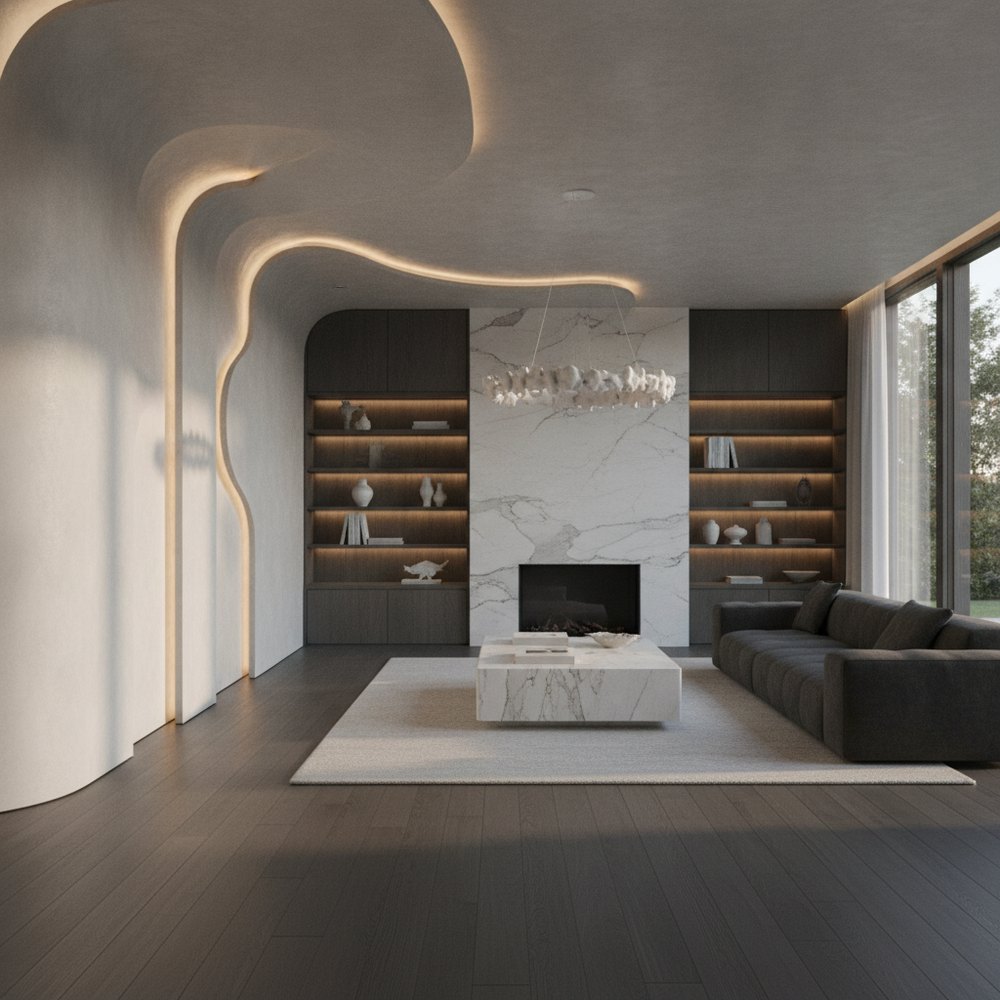
There are three workable strategies for a television: make it the deliberate focal point with symmetrical shelving or joinery around it, hide it behind doors or in a cabinet, or absorb it into a dark wall or panelling so it disappears when off. Pretending it is not there is the fourth option and the only one that never works.
Pick a strategy and commit
Most awkward living rooms are awkward because nobody decided what to do about the television, so it ended up wherever the aerial socket was, on a wall it does not suit, with the furniture arranged around an unacknowledged black rectangle.
The three honest strategies each have a clear cost. Making it the focal point costs you the option of the room being about something else. Hiding it costs money and a small daily friction. Absorbing it costs you a wall colour decision.
The failure mode is trying to have it both ways: a television in the middle of the main wall with a small painting beside it and a plant in front, which reads as an apology rather than a design.
Strategy one: make it the focal point
The simplest and usually the most honest, particularly in a room where television is genuinely the main activity.
The way to do it well is to build a composition around it so it reads as the centre of something rather than an object on a wall. Symmetrical shelving either side. A low media unit beneath at least as wide as the screen. Wall lights or a picture light flanking it. Anything that gives the screen visual company.
The proportions matter: the media unit should be wider than the television, ideally by a good margin, so the screen does not look like it is balancing on something too small. And keep the shelving styled sparsely, since a busy shelf beside a screen is visually exhausting.
Strategy two: hide it
The right answer in a formal living room, a bedroom, or any room where the television is used occasionally.
- Cabinet with doors. A tall cabinet or a run of joinery with doors that close over the screen. Simple, reliable, no mechanism to fail.
- Pocket doors that slide back into the cabinet, so they do not project into the room when open. More expensive and considerably better in use.
- A screen that lifts or drops from joinery. Impressive and the most likely to need servicing in ten years.
- Art-frame televisions, which display artwork when off. Genuinely effective from a distance, less convincing close up, and they carry a price premium.
- Behind a sliding panel or a piece of art on a track, which is a joinery solution and can be very elegant.
Strategy three: absorb it
The cheapest and, in a lot of rooms, the most effective.
A switched-off television is a black rectangle, and the reason it dominates is contrast against a pale wall. Paint the wall behind it a deep charcoal, forest green or navy and the contrast largely disappears. The screen stops being the first thing you see.
Panelling does the same job differently: a wall of vertical battens, a shaker grid, or fluted timber running behind and past the television gives the wall enough visual texture that the screen becomes one element among many.
This is the strategy that requires the least money and the most conviction, since it means committing a whole wall to a dark colour. Our TV wall design guide covers the treatments in detail.
Height, which is where most installations go wrong
Free to get right and uncomfortable to live with when wrong.
The centre of the screen should sit at seated eye level, typically 1 to 1.2 metres from the floor on a normal sofa. Sit down, look straight ahead, and mark where your eyeline hits the wall. That is the centre of the screen, and it is considerably lower than most people mount it.
Above a fireplace, the screen usually ends up at 1.4 to 1.6 metres, which is why it causes neck strain over a long evening. If it must go there, tilt the bracket down and treat the whole chimney breast as one surface so the screen and fireplace read together.
For distance, sit roughly 1.5 to 2.5 times the screen diagonal away. If your room forces you closer, the screen is too large for the room.
Cables and boxes
The detail that separates a built-in look from a bodged one, and it has to be planned before decorating.
The ideal is a recessed back-box behind the screen with a conduit running down inside the wall to the media unit, so nothing is visible at all. On a stud wall this is straightforward; on masonry it means chasing.
If chasing is not possible, a slim surface trunking painted the wall colour is far better than loose cables, and a media unit with a back panel and cable management hides the rest.
Plan a double socket behind the screen as well as below it. Ventilate any closed cabinet holding a set-top box or console, since sealed cupboards cook them. And leave line of sight for remotes or plan an infrared repeater.
Arranging the rest of the room
A few layout points that follow from whichever strategy you chose.
If the television is the focal point, arrange seating to face it and accept that. Trying to create a conversation layout in a room whose main use is watching things produces a room that does neither.
If the room has two focal points, a fireplace and a television, put the television off the main axis and the fireplace on it, or absorb both into one treated wall.
In an open-plan space, use the back of a sofa or a low unit to define the television zone, so the rest of the room can be about something else. Our open plan living guide covers zoning.
Try it on your wall
The dark-wall strategy in particular is one people cannot picture and are convinced by immediately once they see it.
With Decorly you can photograph your living room and compare the television on a pale wall against a dark one, with panelling, or set into joinery, at your real proportions. For the wall treatments, see TV wall design ideas.
Frequently asked questions
How do you decorate around a TV?
Choose one of three strategies and commit: make it the deliberate focal point with symmetrical shelving and a wide media unit, hide it behind doors or in joinery, or absorb it into a dark wall or panelling so it recedes. Placing it on a pale wall with a small painting beside it never works.
What is the cheapest way to make a TV less obtrusive?
Paint the wall behind it a deep colour such as charcoal, forest green or navy. A switched-off screen dominates because of its contrast against a pale wall, and removing that contrast is a tin of paint rather than a joinery project.
What height should a TV be in a living room?
With the centre of the screen at seated eye level, roughly 1 to 1.2 metres from the floor for a normal sofa. Sit down, look straight ahead and mark where your eyeline hits the wall. Most televisions are mounted well above this, which causes neck strain over a long evening.
How do you hide TV cables?
The best solution is a recessed back-box behind the screen with conduit inside the wall down to the media unit, which is straightforward on a stud wall and needs chasing on masonry. Failing that, slim surface trunking painted the wall colour is far better than loose cables.