
Guides
False Ceiling Design Ideas: What Works, What Dates Badly
August 29, 2026 · 9 min read
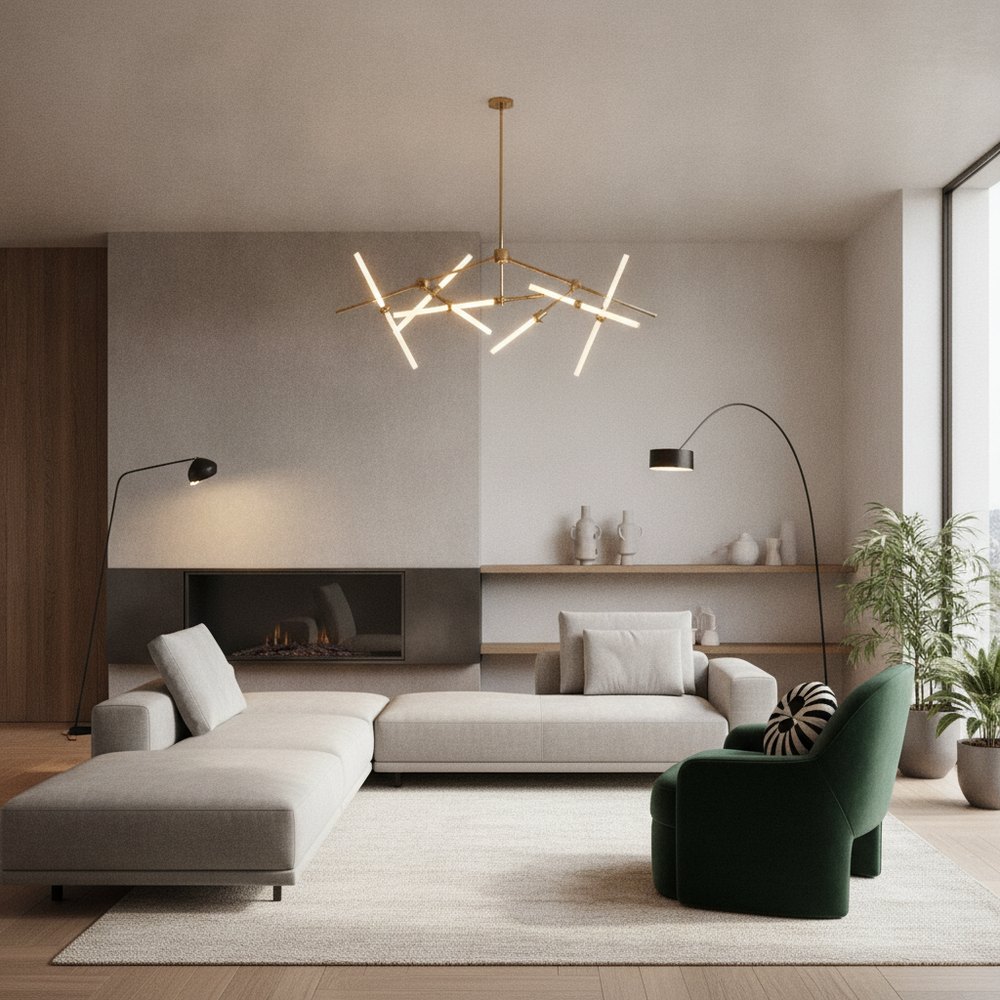
The false ceiling designs that still look good after five years are the restrained ones: a shallow peripheral drop with concealed cove lighting, clean rectangular geometry, and no more than 100 to 150mm of lost height. The ones that date fastest are heavily layered multi-level designs with curved cut-outs and coloured LED strips.
What is a false ceiling actually for?
It is worth separating the three genuine reasons from the one bad reason, because that distinction predicts whether yours will still look right in a decade.
The good reasons are: hiding services, so ducting, wiring and air-conditioning lines disappear; enabling concealed lighting, which is the single biggest quality-of-life upgrade a ceiling can deliver; and correcting a ceiling that is genuinely ugly or uneven. All three are functional, and functional design ages well.
The bad reason is decoration for its own sake, adding levels, curves and cut-outs because the ceiling looked empty. That is the version that reads as dated, because ornamental ceiling fashions move fast and the ceiling is expensive to redo.
How much height can you afford to lose?
This is the constraint that should drive the whole design, and it is the one most often ignored.
A standard room is around 2.7 to 3 metres. Below about 2.6 metres a room starts to feel low, and below 2.4 it feels oppressive to most people. So the arithmetic is simple: if your ceiling is 2.7m, a 150mm drop leaves you at 2.55m, which is fine. A layered design losing 300mm leaves you at 2.4m, which you will feel every day.
The design that solves this is the peripheral drop: the false ceiling runs only around the edges of the room, carrying the lighting and services, while the centre stays at full height. You get the effect and the concealed light without losing the volume.
The designs that hold up
Five approaches that consistently look considered rather than dated.
- Peripheral drop with cove lighting. A shallow band around the room with an upward-facing LED strip washing the central ceiling. Quiet, architectural, and does the most work of anything on this list.
- Single flat plane with recessed spots. Simply a clean, level ceiling with well-planned lighting. Dull to describe, excellent to live with.
- Linear drop over a zone. A single rectangular band over a dining table or an island, defining the zone rather than decorating the ceiling.
- Shadow-gap perimeter. A slim recessed channel where ceiling meets wall, which makes the ceiling appear to float. Expensive to execute well and worth it.
- Timber or slatted feature over one area. Warm, tactile, and reads as material rather than as moulding.
What dates fastest
Not to be prescriptive about taste, but there are patterns that reliably look of-their-moment within a few years.
Multi-level ceilings with three or four stepped tiers. Curved and kidney-shaped cut-outs. Colour-changing RGB strips, which almost always end up left on one colour anyway. Circular drops centred on nothing in particular. Heavy cornice mixed with modern geometry. And any design where the ceiling is competing with the room rather than serving it.
The test is straightforward: if the ceiling is the first thing a visitor comments on, it is probably doing too much.
Lighting is the whole point
Most people commission a false ceiling and then treat the lighting as a detail, which is backwards.
The reason to build one at all is usually that it lets you do things a flat concrete ceiling cannot: cove lighting that washes upward and makes the ceiling glow, recessed spots that disappear, and linear profiles that light a work surface without a visible fitting. Get the lighting layout designed first, then build the ceiling around it.
Three practical rules. Keep the colour temperature warm, around 2700K to 3000K, in living spaces. Put the cove lighting and the spots on separate switches, because you will want them independently. And do not ring the room in downlights on a two-metre grid, which is the classic error that turns a living room into an office.
Gypsum, POP or timber?
The material choice is mostly practical rather than aesthetic, since all three can be finished to look similar.
- Gypsum board on a metal frame. The standard for good reason: fast, dimensionally stable, easy to access afterwards, and takes a crisp edge.
- POP (plaster of Paris). Cheaper in many markets and allows curves and mouldings, but heavier, more prone to hairline cracking, and harder to open up later if a service fails.
- Timber or slatted panels. For feature areas rather than whole ceilings. Adds warmth and acoustic softening; costs more.
- Access matters. Whatever the material, plan an access hatch anywhere a joint, valve or junction box is buried. Cutting a hole in a finished ceiling later is nobody's favourite afternoon.
Room by room
The right answer differs by room more than most guides admit.
In a living room, a peripheral drop with cove lighting is usually the sweet spot. In a bedroom, keep it minimal and keep the light warm and low; a ceiling full of spots above a bed is a mistake you notice at 11pm. Over a dining table, a single linear drop that frames the table is the strongest move. In a kitchen, function wins: a flat ceiling with well-placed task lighting and good extraction routing. In a small room or a low room, the honest answer is often not to build one at all.
See it in your own room first
Ceilings are exceptionally hard to judge from drawings, because the effect is about proportion and light rather than shape on paper.
With Decorly you can photograph your room and render different ceiling and lighting treatments against your real ceiling height and window light, which is the only way to feel whether a drop will make the room cosier or lower. For the lighting decisions that follow, see best lighting for every room and statement lighting ideas.
Frequently asked questions
How much height does a false ceiling take?
A simple design with concealed lighting needs about 100 to 150mm. Layered multi-level designs commonly take 250 to 300mm or more. Since rooms start to feel low below about 2.6m finished height, do the arithmetic before choosing a design rather than after.
Which false ceiling design does not look dated?
Restrained ones. A shallow peripheral drop with concealed cove lighting, a clean flat plane with well-placed recessed spots, or a single linear band over a dining table. Multi-level tiers, curved cut-outs and colour-changing LED strips are what date fastest.
Is a false ceiling worth it in a small room?
Often not. In a small or low room the height you lose costs more than the lighting you gain. If you want concealed light in a small space, consider a peripheral drop on one or two sides only, or wall-mounted uplighting instead.
Gypsum or POP for a false ceiling?
Gypsum board on a metal frame is the more reliable choice: faster, dimensionally stable, crisp edges, and easier to access later. POP is cheaper in many markets and allows curves, but it is heavier, more prone to hairline cracks and harder to open up if a buried service fails.